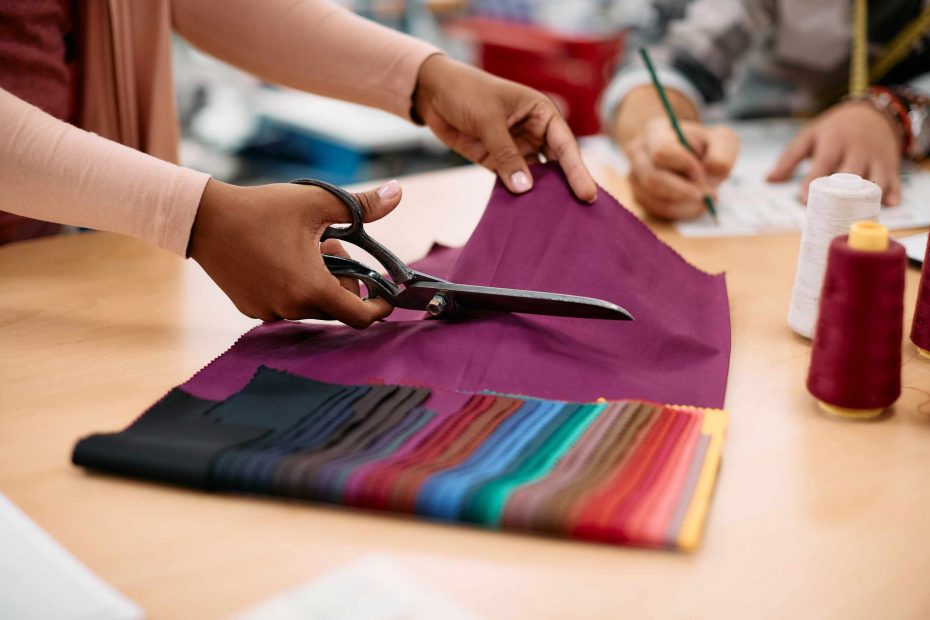
Choosing the right fabric for your initial practice piece can be the difference between a straightforward exercise and a frustrating one. While some new students might feel tempted by fabrics like thick upholstery, satin, or knit, you should probably begin with a small swatch of stable woven cotton. This does not imply that you will never sew any other type of textile but rather that there are fabrics which will tend to curl, move, stretch and fray more than the new practitioner might be able to deal with.
To test the fabric, place a few samples on the table and handle them to see how it feels. Note the thickness, how the fabric drapes, and if it frays as you run your hand along the edge. Pull on it both vertically and horizontally to see if it stretches. A woven fabric is generally more stable than a knit fabric, and this is important when learning to make a straight cut, work with seam allowance and create simple hems.
Select fabric for your first swatch that is marked easily without using a heavy or permanent marker and that is not so textured that you have difficulty marking on it. Use a tailor’s pencil, or another appropriate marking tool. It should draw a visible line. But do not use fabric that is difficult to mark with this method. Fabric that shifts when touched will be a distraction to a beginner. Look for a swatch that is flat and can be pinned without changing shape, and doesn’t shift when folded over.
Another quality to consider is whether the fabric frays easily. The edge of the fabric can become frayed right away, especially if the weave is open or very soft. A certain amount of fraying is not necessarily a drawback as it teaches about edges, but it may make it difficult to sew a neat seam during the very first practice if you are not skilled at dealing with it. Cut a swatch and then gently rub the edge with your fingertips to see if it frays quickly. If so, pick a different sample for now.
With the fabric sample chosen, do the following: lay it on the table so it is completely smooth. Using a measuring tape or seam gauge, make a mark on the edge to ensure it is on the straightest line. Pin the fabric on the line, without distorting it. Cut on the line slowly with sharp fabric shears and notice the cut edge. The exercise is not meant to create a good looking piece of fabric. The purpose is to determine how easy it is to use the tape measure, ruler, tailor chalk, pins, and cutting tool, in relation to your fabric choice.
Thread and needle choice is also facilitated by the use of simple materials. It is much easier to practice a running stitch or back stitch, stitch spacing and even thread tension using a simple medium-weight cotton sample, because it allows the needle to enter smoothly. If the material is too thick, you may feel the urge to push the needle harder than you should. If the material is too fine, the thread may cause a small puckered effect on the fabric. The fabric should stay straight so that you can notice when your hand is moving in an awkward way.
It is a good idea to keep the fabric sample after you use it so that you will have a record of your experience. On the scrap of fabric, note if it was easy to mark, difficult to cut, did it fray a bit or a lot, were your seams even, was your hem even, or did your thread cause puckering? Keep this information with the scrap for later reference. You can see each fabric as a material in its own right. Your first fabric may not necessarily be the prettiest piece of fabric you’ve ever held. It is the fabric that enables you to clearly follow your practice instructions to help your body and hands understand the sewing process.